
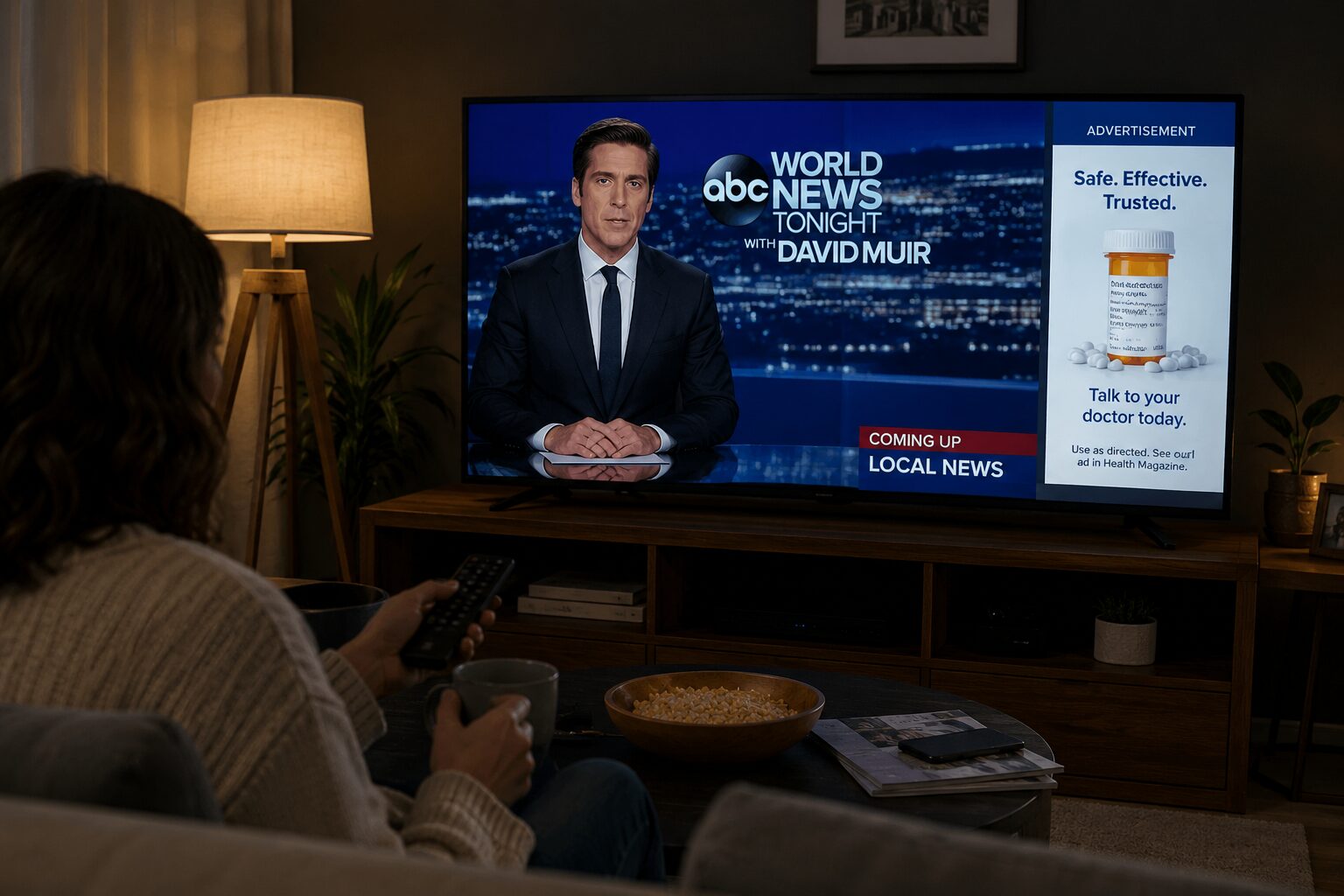

Why Does ABC World News Tonight Have So Many Commercials at the End?
ABC World News Tonight packs most of its commercials into the back half of the broadcast because the show front-loads its biggest stories to hook viewers early, then uses that captive, older, pharma-friendly audience to sell advertisers a premium slot right before local news takes over. It’s not an accident or a technical glitch — it’s a deliberate structure that nearly every major network news broadcast uses, and once you see the pattern, you’ll notice it on NBC Nightly News and CBS Evening News too.
If you’ve ever felt like you watched five minutes of actual news squeezed between eight minutes of drug commercials, you’re not imagining it — and there’s a clear business logic behind why it’s built that way.
Key Takeaways
- A 30-minute nightly newscast typically contains only about 18 to 22 minutes of actual news, with the rest split across two or three commercial breaks.
- Studies analyzing broadcast timing found that the overwhelming majority of ad time comes after the overwhelming majority of the news has already aired (AFRA broadcast advertising analysis).
- Pharmaceutical companies spent an estimated $15 million in a single month advertising on ABC World News Tonight with David Muir, based on Adweek-reported figures — a pace that would total roughly $180 million a year for one broadcast.
- Adults 65 and older watch over 5 hours of linear TV a day on average, making evening news one of the most valuable ad slots left on broadcast television for reaching that demographic (eMarketer, 2025).
- The heavy back-loaded ad structure exists partly to smoothly hand viewers off to affiliate local news broadcasts immediately afterward, keeping the audience tuned to the same channel.
Why Do Networks Put Most Commercials at the End of the News?
Networks put most commercials near the end of the broadcast because the strategy front-loads compelling headline stories to keep viewers watching, then cashes in that attention with a concentrated stretch of ads once the audience is already invested. Broadcast advertising researchers who analyzed multiple nightly news programs found this same pattern across networks: the overwhelming majority of advertising comes after the overwhelming majority of the news has been reported, not spread evenly throughout the show.
This isn’t unique to ABC — it reflects how a 30-minute newscast is actually built. According to breakdowns of how TV news is structured, a half-hour broadcast is typically divided into three blocks separated by two commercial breaks, with the first block reserved for the most important national news to hook viewers immediately. Analysts have also noted that after removing commercials, teases, weather, and sports, a 30-minute newscast may contain only 8 to 10 minutes of pure news content in some cases — though most nightly broadcasts land closer to 18–22 minutes of news out of 30.
Practically, this means the structure isn’t random. It’s engineered the same way a prime-time TV schedule is engineered — hook early, monetize late.
Why Are There So Many Drug Commercials on ABC World News?
There are so many pharmaceutical commercials on ABC World News Tonight because drug advertisers specifically target the older, health-conscious demographic that watches network evening news, and they’re willing to pay premium rates to do it. Adults 65 and older spend over 5 hours a day with linear TV on average — far more than any other age group — which makes evening newscasts one of the most efficient ways left for pharma brands to reach that audience (eMarketer, 2025).
The numbers behind this are substantial. Pharmaceutical and over-the-counter brands spent nearly $6 billion on national TV drug advertising in 2025 alone, with categories like weight-loss drugs, depression and mental health medications, and cancer treatments seeing some of the largest year-over-year increases (eMarketer, 2026). One report specifically cited ABC World News Tonight with David Muir as pulling in around $15 million in pharmaceutical ad spend in a single month — a run rate that would total roughly $180 million a year for just one 30-minute broadcast.
This concentration explains a common viewer complaint: watch any given episode, and it’s common to count 8 or more commercials in the back half of the show, with a large share advertising prescription medications rather than general consumer products. It isn’t that ABC specifically favors pharma ads — it’s that pharma companies are consistently among the highest bidders for this exact advertising demographic.
Does the Structure Help Hand Viewers Off to Local News?
Yes — the heavy end-of-broadcast ad load is also designed to smoothly transition viewers from the network newscast directly into the local affiliate’s news broadcast that typically follows. ABC stations have historically scheduled World News Tonight in a lead-in position specifically to keep viewers tuned to the same channel once local news begins, rather than losing them to a competing network (Wikipedia, ABC World News Tonight).
This “lead-out” strategy matters commercially in two ways:
- It protects local ad revenue. Local affiliate stations sell their own commercial inventory during the news that follows, so keeping viewers engaged through the network broadcast’s final minutes directly benefits the local station’s bottom line too.
- It reinforces the front-load structure. Because viewers are more likely to click away during a long commercial block than during an actual story, placing the heaviest ad load right before the handoff to local news minimizes the risk of losing viewers mid-story.
This is also why closing segments — like ABC’s long-running “Person of the Week” feature — are placed at the very end, after the last commercial break. A warm, feel-good closing story is a proven way to keep viewers watching through to the literal final seconds, right up until the local news begins.
How Much of a Nightly Newscast Is Actually News?
On average, a standard 30-minute network newscast contains somewhere between 18 and 22 minutes of actual news content, with the remaining 8 to 12 minutes split across two or three commercial breaks. This ratio has shifted meaningfully compared to decades past — earlier prime-time programming in the 1950s and 60s typically ran only 8–9 minutes of commercials per hour-long slot, or roughly 13–15% of total airtime, compared to the higher commercial density common in half-hour newscasts today.
A few structural details worth knowing:
- The first 10–15 minutes are usually commercial-light, reserved for the biggest national and international stories of the day.
- Commercial breaks fluctuate between 1 and 3 minutes each, typically increasing in frequency and length as the broadcast approaches its final segments.
- Sports, weather, and teases for upcoming stories eat into the “news” minutes further, meaning the actual hard-news content can be shorter than the runtime suggests.
If you’re comparing network news ratings or trying to figure out which broadcast gives you the most actual news per minute, checking how commercials are distributed throughout the show — not just how many total minutes it runs — is a better measure than the nameplate runtime alone.
Is This Only an ABC Problem, or Do NBC and CBS Do It Too?
This is not unique to ABC — NBC Nightly News, CBS Evening News, and most other major network newscasts use the same front-load-news, back-load-ads structure, because it’s driven by broadcast economics rather than any one network’s editorial choices. Viewer complaints about heavy end-of-show commercial blocks appear just as often directed at NBC and CBS as they do at ABC, and studies comparing multiple networks’ advertising timing found the same overall pattern across the board.
Where networks do differ somewhat is total commercial load and specific ad mix — one comparative study found a foreign nightly news broadcast ran a notably higher ratio of uninterrupted news to advertising than typical U.S. network newscasts, largely because it isn’t funded the same way through domestic TV advertising. That comparison highlights just how much U.S. network news economics — not audience preference — shapes the commercial structure viewers experience every night.
Frequently Asked Questions
Why does ABC World News Tonight repeat the same headlines multiple times?
The repetition of headlines at the top of the broadcast, then again within each individual story, is a structural choice designed to re-hook viewers who may have just tuned in and to reinforce retention through commercial breaks — not a scripting mistake. It’s a long-standing convention across network news broadcasts, not unique to ABC.
How many commercials are typically in a 30-minute newscast?
Analyses of individual broadcasts have found totals ranging from around 10 to 16 commercials per 30-minute episode, with a large share concentrated in the back half of the show. One widely cited breakdown counted 13 commercials totaling roughly 8 minutes across a single broadcast, with the majority airing in the final 11 minutes of the show.
Why are so many of the commercials for prescription drugs?
Prescription drug advertisers pay some of the highest rates for evening news airtime because the audience skews older and more health-conscious than nearly any other TV demographic. Pharmaceutical companies spent nearly $6 billion on national TV drug advertising in 2025, with network news programs consistently ranking among the top destinations for that spending (eMarketer, 2026).
Will streaming and cord-cutting eventually reduce the number of commercials on network news?
Ad spending is already shifting: pharmaceutical and healthcare advertisers are expected to keep increasing digital ad spend while gradually reducing traditional linear TV spending in the coming years, according to industry forecasts (Fierce Pharma, 2025). That said, older viewers remain heavily concentrated on linear TV, so network news is likely to stay a priority ad destination for years even as overall spending patterns shift toward streaming and connected TV.
Final Thoughts: It’s Business, Not a Broadcasting Accident
The commercial-heavy back half of ABC World News Tonight isn’t a scheduling oversight — it’s the direct result of a business model built around hooking viewers with front-loaded headlines, then selling that captive, older audience to the advertisers most willing to pay for it, largely pharmaceutical companies. The same structure shows up across nearly every major U.S. network newscast, which is why the complaint feels so universal among longtime evening news viewers.
Understanding the economics behind the structure doesn’t make the ad load less noticeable — but it does explain exactly why the “real news” always seems to get shorter while the commercial blocks at the end keep growing.
Sources referenced: Wisconsin Watch (2025), eMarketer (2025, 2026), Fierce Pharma (2025), Sportico (2025), Adweek (via Mark Hyman Substack), AFRA broadcast advertising analysis, Wikipedia (ABC World News Tonight), Borden’s Blather broadcast timing analysis (2020).